Owning one
Range, Battery and Terrain
Up to 100 km on the flat, about half that on hills - and why the battery was chosen for cycle life rather than weight.
The short answer
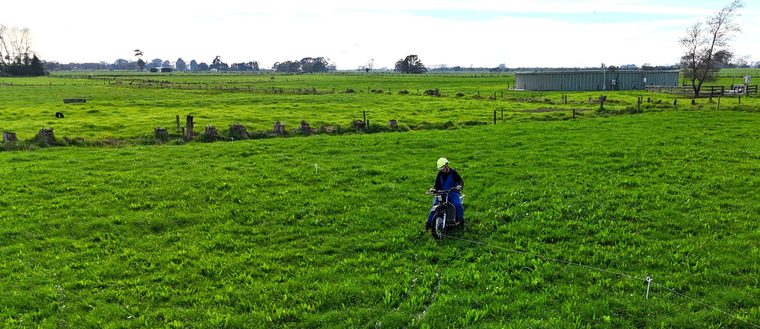
Up to 100 km on flat dairy country, which is two to three days of work on a typical platform. On rolling country expect roughly half that.
Size it against your longest day, not your average one. That single check decides whether an electric bike suits your farm.
Range is the one specification worth being genuinely careful about, because it is the only place a petrol bike has a real advantage - a tank goes further between stops, and you can refill it in two minutes.
Whether that matters depends entirely on the shape of your farm, so here are the numbers with the caveats attached.
On flat dairy country
A working day of cups, breaks, troughs, fences and gates on the average 160-hectare platform is typically 15 to 25 km - two to three days between charges.
~50 kmOn rolling hill country
Roughly half the flat-ground figure, and the climbing itself gets easier.
3 kWhLFP battery
3,032 Wh at 54.7 V nominal, chosen for cycle life and safety rather than for weight. Four to five hours from empty.
Hills use more, and climb better
On rolling country expect roughly half the flat-ground figure. That is the honest number and it is the one to plan against.
What you gain in exchange is the climbing itself. An electric motor makes full torque from a standstill, so there is no clutch to slip and nothing to stall on a steep wet face - you twist and it goes. On a petrol bike that same climb is a gear selection and a clutch you are feathering while a mob watches.
Load changes the number
Payload is 200 kg including the rider. A fully loaded bike uses noticeably more energy per metre climbed than a solo rider, which is worth knowing when you are planning a long day with fencing gear and a dog on the deck.
It is the same physics on a petrol bike; you just do not notice it, because the fuel gauge moves slowly and the tank is easy to top up.
Why the battery is LFP
The Galvbike uses lithium iron phosphate - LFP. It is slightly heavier than other lithium chemistries for the same capacity, and that is a deliberate trade rather than a compromise.
Thousands of cycles, not hundreds
LFP cells typically last thousands of charge cycles before capacity drops meaningfully. On daily farm use that is years of service rather than months.
Far harder to push into thermal runaway
LFP is markedly more resistant to thermal runaway than the chemistries used in most consumer devices, and much harder to set alight even when damaged. In a hay shed, that matters.
You do not have to nurse it
Running an LFP pack flat every day does not shorten its life the way it would with other chemistries. Use it and charge it.
What actually drains a battery
Four things move the number, and only one of them is distance. Knowing which is which is the difference between planning a day accurately and guessing at it.
The big one
Lifting a loaded bike up a hill is the single largest draw. Flat kilometres are cheap; vertical metres are not. This is why the hill-country figure is roughly half the flat one rather than slightly under it.
Second biggest
Every kilogram on the deck has to be carried up every climb. A full load of fencing gear changes the range meaningfully on rolling country and barely at all on the flat.
Smaller than expected
Drag rises with speed, but farm work rarely happens at 50 km/h. Most of a farm day is spent well below the speed where this matters.
Marginal in NZ
Lithium chemistry loses a little capacity in the cold. New Zealand winters are mild enough that this is a rounding error rather than a planning factor.
Charging fits the day, not the other way round
Four to five hours from empty on a standard socket. Plug it in after milking and it is full before the next one, which for most farms means the range question never actually comes up in practice - only in the buying decision.
What it costs to charge is covered in running costs. Whether the range suits your operation specifically is on which farms it suits.
Pre-orders open
Ready to put one to work?
Built for New Zealand farms, delivered anywhere in the country.
- $7,790+ GST
- 2 yearsWarranty
- 200 kgPayload
- 50-100 kmRange
First batch sold out - taking pre-orders for March 2027 delivery.