Owning one
Durability and Servicing
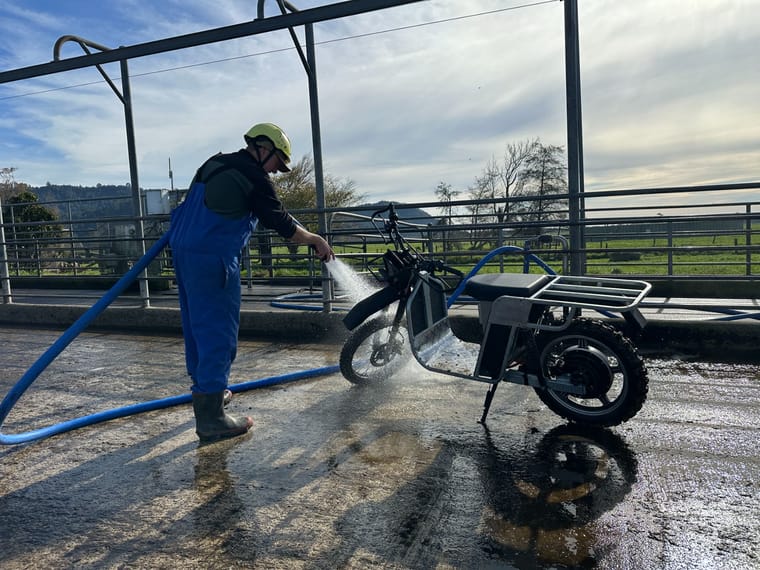
What finishes farm bikes in this country is not hours on the clock. It is the hose, the effluent and the yard.
The short answer
The frame is hot-dip galvanised - coated inside the tube as well as out - and the motor is rated IP67. Point the pressure washer wherever it needs to go.
The complete service list is brakes, tyres and occasional grease. Everything a petrol bike needs annually does not exist here.
Farm bikes in New Zealand do not usually die of engine hours. They die of what is on the yard, in the race and in the effluent pond, combined with a hose pointed at them every day for years.
Every other bike on the market is painted steel. That is the single biggest reason this one is built the way it is.
Sealed motor
Sealed against dust and protected against immersion. In practice: the pressure washer can go where it needs to go.
GalvanisedNot painted
The one build decision that settles how long a farm bike lasts.
2 yrWarranty behind it
Twice the cover on the other electric farm bike, plus your rights under the Consumer Guarantees Act.
Galvanised, not painted
Paint is a film. It chips, and once it does, a dairy environment gets underneath it and the rot starts working outward from a place you cannot see. Hot-dip galvanising does not work that way - the coating is bonded through the steel and applied inside the tube as well as outside, so there is no film to breach.
It is not a cosmetic decision. On a farm that hoses down twice a day, it is the difference between a frame that lasts and one that quietly corrodes from the inside.
Fewer things for water to ruin
The other half of the durability story is what is absent. Water and effluent ruin specific components, and most of those components are not on this bike:
Nothing to rust and seize
A chain is the part that suffers most in a wash-down environment, and the one that needs the most attention because of it.
Nothing to gum up
No fuel to go stale over winter and no carburettor to clean out in spring.
Nothing to soak
One less consumable, and one less thing to check after a wet week.
Electrics and motor
Sealed throughout rather than protected by position, which is what most machines rely on.
The entire service list
Brakes, tyres, and occasional grease through the swingarm nipples. Forks and shocks are conventional and may eventually need seals. That is genuinely the whole list.
What is not on it: chain adjustment, chain and sprocket replacement, clutch plates, gearbox, engine oil, oil filter, air filter, spark plug, carburettor. Those are the recurring jobs on a petrol farm bike and they are where the real cost of ownership sits - see running costs for what that adds up to.
How to wash one down
There is no special procedure, which is the point - but two habits are worth having anyway, and they apply to any farm bike:
Before you scrub
Effluent is abrasive once it dries. A rinse before the brush saves the finish on anything, galvanised or not.
The motor is sealed
IP67 means you are not working around the machine trying to keep water off it. Point the hose where the muck is.
Common sense, not a rule
Plug in once the charge port is dry. The connector is designed for a farm, but there is no reason to make it work harder than it needs to.
A local mechanic can work on it
Brakes, tyres, bearings, forks and shocks are conventional components in standard sizes. A rural mechanic does not need special training or a franchise agreement to work on the running gear, which matters when the nearest dealer is two hours away.
Even the job people ask about most - changing a rear tyre with a hub motor in the wheel - is straightforward. The motor and wheel come off together as one assembly; the cable detaches with a few screws and unplugs from the control box. The tyre then changes on the rim like any other.
Commonly asked
Can you pressure-wash a Galvbike?
Yes. The motor is IP67 - sealed against dust and protected against immersion - and the frame is hot-dip galvanised. It was designed around the hose.
What kills farm bikes in New Zealand?
Not hours on the clock. Water, effluent and a pressure washer pointed at the machine every day.
Pre-orders open
Ready to put one to work?
Built for New Zealand farms, delivered anywhere in the country.
- $7,790+ GST
- 2 yearsWarranty
- 200 kgPayload
- 50-100 kmRange
First batch sold out - taking pre-orders for March 2027 delivery.